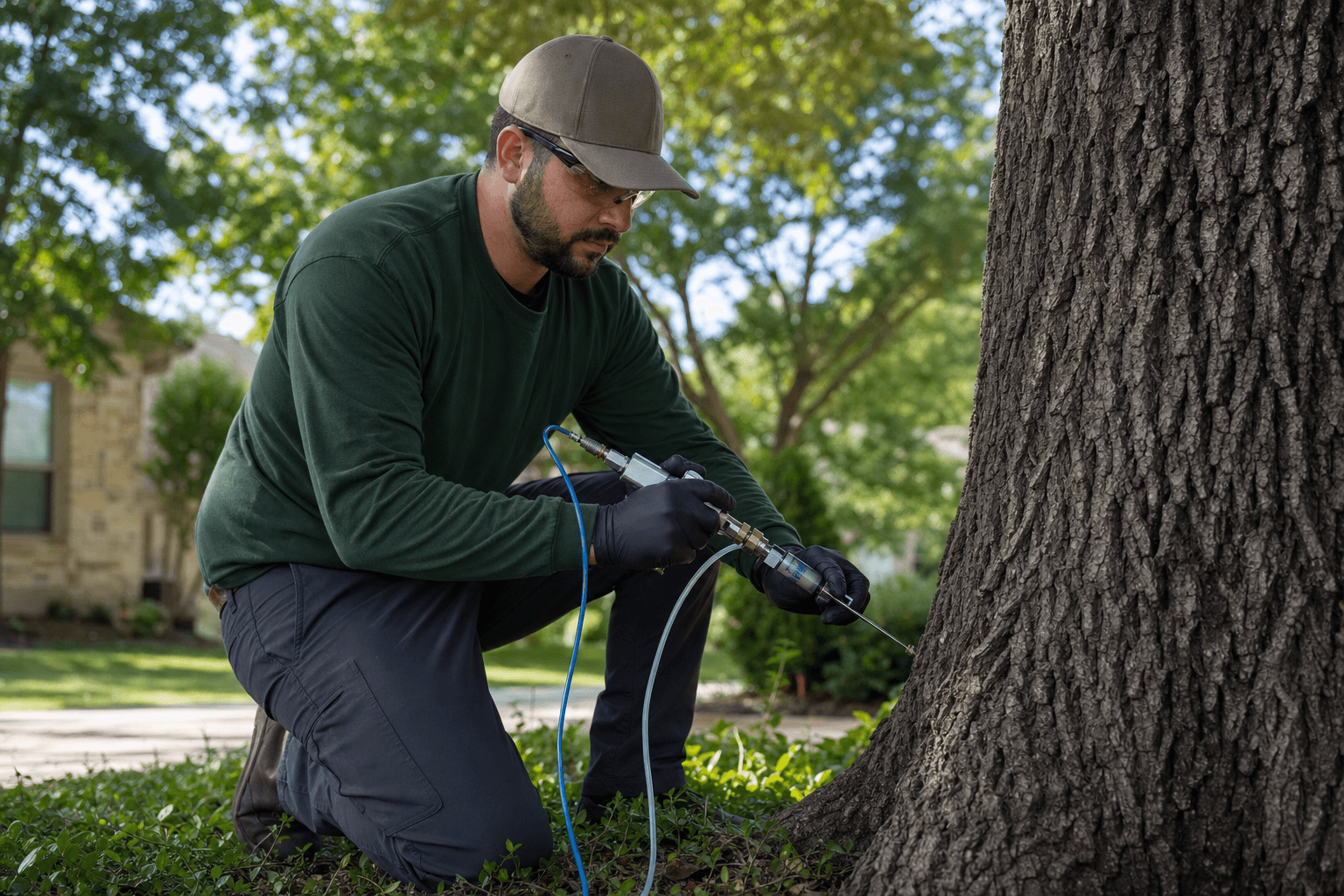
Arbor Jet trunk injections deliver pesticides, fungicides, or nutrients directly into a tree's vascular system through small ports drilled into the base of the trunk. The treatment bypasses the soil and the leaf surface entirely, placing the active ingredient exactly where the tree's circulatory system can move it. For Cedar Park and Georgetown-area trees under heat and pest pressure in July, this approach is significantly more effective than foliar or soil-applied alternatives.
Key Takeaways
- Arbor Jet injections deliver treatment directly into the tree's vascular system, making them more effective than foliar sprays in high-heat, drought-stressed conditions.
- Cedar Park's clay-limestone soil limits how well soil-applied treatments move toward tree roots, making trunk injection the more reliable delivery method.
- The process typically takes 30 to 90 minutes per tree depending on diameter, and most trees show measurable improvement within two to four weeks.
- Common triggers for treatment include oak wilt symptoms, emerald ash borer pressure, hypoxylon canker, and severe nutrient deficiency.
- Green Dream Lawns serves Cedar Park and the surrounding region from our base in Florence, TX, with Arbor Jet injection services available as a standalone or as part of a broader plant and tree care program .
What the Arbor Jet System Actually Does Inside the Tree
The Arbor Jet system works by creating a sealed connection between a pressurized injection port and the tree's xylem tissue, the network of vessels that moves water and dissolved nutrients up from the roots. Once the port is seated, the treatment solution is pushed in at a controlled pressure, and the tree's own vascular flow distributes it through the canopy. Depending on the product being used, that distribution can reach the outer branches within hours or over the course of several days.
This matters in Cedar Park specifically because the conditions here make surface applications unreliable. Foliar sprays wash off, break down in direct sun, or simply don't penetrate dense canopy at the concentrations needed to address a serious infestation or disease. Soil drenches face the same problem described above: clay-dominant soil doesn't move solution efficiently toward feeder roots, especially when that soil is dry and cracked in July. Trunk injection sidesteps both limitations entirely.
The products we use through the Arbor Jet system are labeled for specific pathogens, insects, and deficiencies. For a live oak showing early signs of oak wilt, we'd use a fungicide formulation designed to move through the xylem and interrupt fungal spread. For a tree with a bark beetle infestation or emerald ash borer pressure, we'd use an insecticide that makes the tree's own tissue toxic to the pest. For a tree showing chlorosis or general decline from nutrient stress, a macro or micronutrient solution can be injected directly. The chemistry changes based on the diagnosis, but the delivery method is the same.
This is also why we pair Arbor Jet work with a thorough assessment before we drill a single port. Injecting the wrong product into a stressed tree doesn't help, and in some cases can accelerate decline. Our team evaluates canopy color, bark condition, soil compaction, and recent weather patterns before recommending a treatment protocol. For trees on properties where we're already managing plant insect and disease control or plant fertilization , we often have baseline data that makes that assessment faster and more accurate.
What Does the Arbor Jet Injections Cedar Park, TX Process Look Like on Your Property?
The physical process is less invasive than most homeowners expect. We drill a series of small ports around the base of the trunk, typically at a downward angle just into the cambium layer. The number of ports depends on the diameter of the tree: a 12-inch trunk might need four ports, while a large heritage oak with a 36-inch trunk might need eight or more to ensure even distribution. Each port is fitted with a sealed plug that connects to the injection system.
Once the ports are in place, we connect the pressurized Arbor Jet unit and begin the injection. The solution moves in at a controlled rate, and we monitor uptake as it progresses. For most residential trees in Cedar Park, the full process runs between 30 and 90 minutes. After the injection is complete, the ports are sealed with wound plugs that protect the entry points while the tree compartmentalizes the small openings on its own.
There's no runoff, no overspray, and no waiting period before people or pets can return to the area. That's a meaningful difference from broadcast insecticide applications, and it's one reason arbor jet injections cedar park, tx is a preferred option for properties with children, dogs, or proximity to drainage areas that feed into Brushy Creek or Lake Georgetown.
Most trees show visible improvement within two to four weeks, though the timeline varies based on the severity of the problem and how efficiently the individual tree is moving water at the time of treatment. A tree that's already severely drought-stressed may uptake solution more slowly than one that's well-irrigated. This is one reason we sometimes recommend scheduling injections after a good rain event or a targeted watering of the root zone.
How Do You Know If Your Tree Actually Needs This Treatment?
The signs that a tree needs trunk injection treatment fall into a few clear categories. Canopy thinning or premature leaf drop in July is one of the strongest indicators, particularly in live oaks, which should be holding dense green foliage through the summer. Yellowing between leaf veins, called interveinal chlorosis, often signals an iron or manganese deficiency that soil application won't correct efficiently in our alkaline Central Texas soils. Bark discoloration, weeping wounds, or the presence of fine sawdust-like frass near the trunk base point toward boring insect activity that needs to be addressed from the inside out.
Oak wilt is a particular concern in this region. The fungal pathogen Bretziella fagacearum spreads through root grafts between neighboring trees and through sap beetles that carry spores from infected wood. If you've seen a neighbor's oak decline rapidly, or if you're near one of the known oak wilt pressure zones in Williamson County, getting ahead of potential infection with a preventive injection is worth serious consideration. The disease pressure we've tracked across Cedar Park this season suggests that tree health shouldn't be treated as a separate concern from overall property management.
If you're also managing turf health on the same property, conditions that stress your trees often overlap with conditions that stress your lawn. Compacted soil, inconsistent moisture, and summer pest pressure affect both. Our team handles lawn insect control , lawn disease management , and aeration alongside tree care, so we can assess the full picture during a single site visit. We serve Cedar Park , Leander , Round Rock , Liberty Hill , and Georgetown from our Florence, TX location.
Frequently Asked Questions
How long does an Arbor Jet injection treatment last?
Most treatments remain active in the tree's vascular system for one to two years, depending on the product used and the tree's overall health. In Cedar Park's alkaline soil conditions, nutrient injections sometimes need to be repeated annually because the soil itself continues to limit natural uptake. Our team will recommend a follow-up schedule based on what we observe during the initial treatment.
Will the injection ports damage my tree?
The ports are small, typically about 3/16 of an inch in diameter, and trees compartmentalize these wounds the same way they respond to any minor bark injury. On a healthy tree, the entry points are essentially invisible within a growing season. We avoid drilling into trees that are already severely compromised, because the stress of injection may outweigh the benefit in those cases.
Can Arbor Jet injections be used preventively, or only after a problem appears?
Preventive injection is one of the most effective uses of the system, particularly for oak wilt and emerald ash borer. If you have high-value trees on your Cedar Park property and there's known disease or pest pressure in the surrounding area, treating before symptoms appear gives the active ingredient time to distribute fully through the canopy before the threat arrives. Waiting until visible decline begins often means the treatment is working against a more advanced problem.
Do I need to water my tree before or after an injection?
Adequate soil moisture improves uptake because the tree's vascular system moves more efficiently when it's actively transpiring. In July, with Cedar Park temperatures regularly pushing above 100 degrees, we recommend a deep watering of the root zone 24 to 48 hours before a scheduled injection if rainfall hasn't provided it. After the treatment, maintaining consistent moisture helps the tree distribute the solution and begin recovery.
If you have trees showing stress symptoms this July, or if you want a preventive assessment before peak heat takes a further toll, reach out to our team to schedule an evaluation. Arbor jet injections cedar park, tx treatments are most effective when the tree still has enough vascular function to move the solution, which means earlier in a decline is always better than later.
Need Help With This Service?
Request a quote and we will build a practical lawn plan for your property.
Book Consultation