
Why Leander's Growth and Soil Create a Persistent Fire Ant Problem
Leander has grown faster than almost any city in Texas over the past decade. The buildout along Ronald Reagan Boulevard, the expansion into Bryson and Carneros Ranch, the new phases going up near 183A, all of that construction activity disturbs soil on a massive scale. Disturbed soil is where fire ant colonies relocate. When a colony feels threatened or senses a change in its environment, it does not die. It moves. New construction pushes colonies from one lot into adjacent established yards, and that cycle repeats every time a new phase breaks ground nearby.
The clay-dominant soil that sits under most of Leander also plays a direct role. Fire ants prefer to build in soil that retains warmth and holds some moisture, and Central Texas clay does both. Unlike the sandier profiles you find further south, Leander's soil gives colonies structural stability and insulation. That is part of why mounds here can run deep, sometimes 18 to 24 inches below ground, meaning surface treatments that only address the top few inches of a colony often miss the queen entirely. If the queen survives, the colony survives.
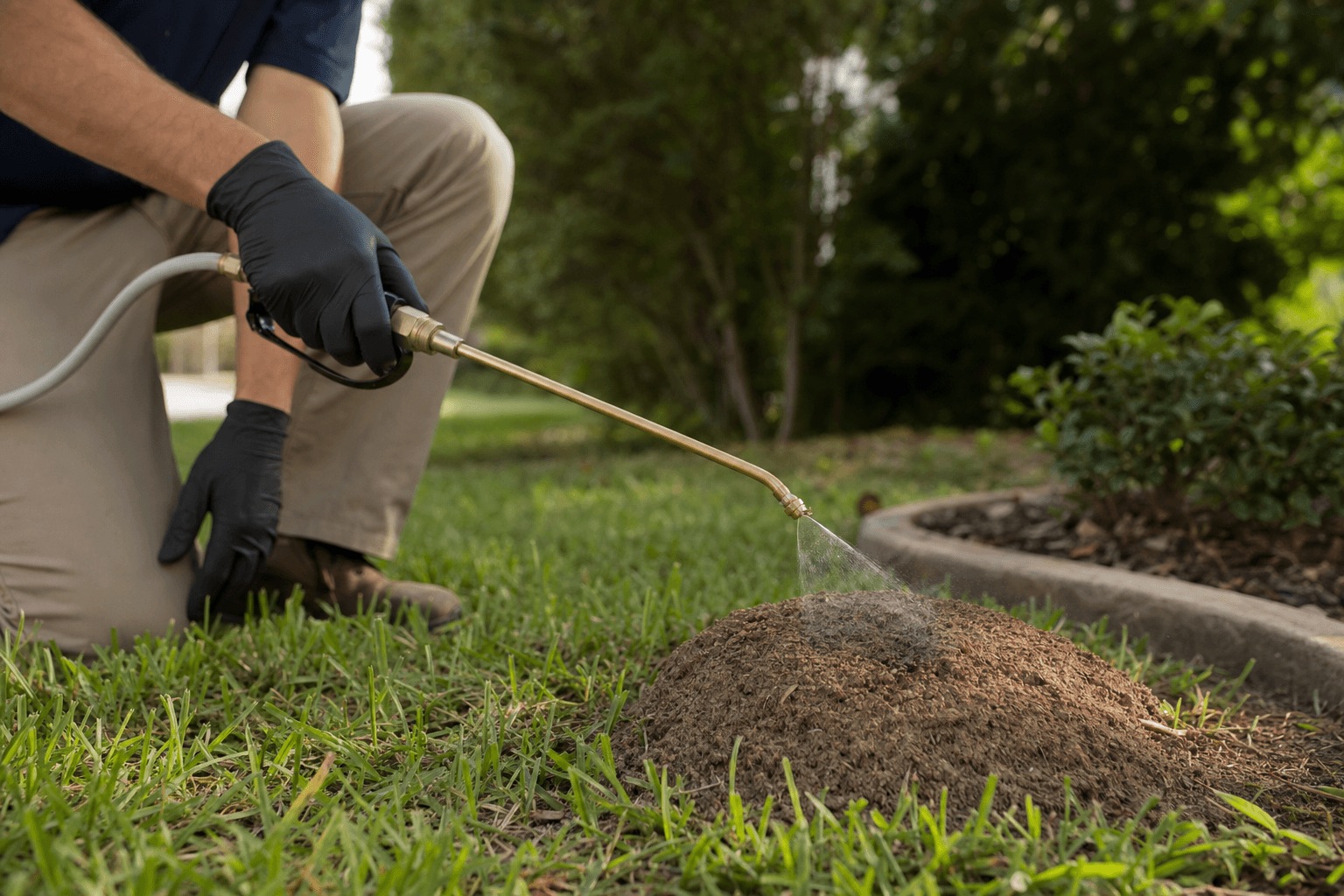
Our fire ant control approach accounts for this. We use a combination of broadcast bait treatments across the full lawn and targeted mound drenches for active colonies. The bait works by moving through the forager ants back to the queen, which is the only way to collapse a colony from the inside out. Timing matters here too. In June, fire ant foragers are most active in the early morning and late evening when soil temperatures are slightly cooler, so application timing affects how much bait gets picked up and carried back.
What Makes Fire Ant Control Leander TX Different From a One-Time Spray
A lot of homeowners assume fire ant treatment is a one-and-done event. Apply something, the mound dies, move on. That is rarely how it works in this part of Williamson County, and we have written about similar dynamics in our article on fire ant control in Georgetown if you want a deeper look at how the regional biology plays out across different soil types.
The reality is that fire ant management is seasonal and ongoing. A single treatment in June will reduce the population significantly, but fire ants are persistent re-colonizers. Colonies from neighboring properties, from undeveloped lots along the Leander city limits, and from green spaces near Devine Lake Park can repopulate a treated yard within a season if there is no follow-up program in place. We recommend a minimum of two treatments per year for most Leander properties, with the first in late spring and the second in early fall before colonies begin their pre-winter consolidation phase.
For homeowners who are also dealing with broader lawn insect pressure , fire ants are not the only pest that peaks in June. Chinch bugs, army worms, and grubs all become active around the same time, and a lawn that is already stressed from insect feeding is more vulnerable to fire ant colonization. We often pair fire ant treatments with a broader grub control program for properties that show signs of multiple pest pressures.
Protecting Kids, Pets, and Outdoor Spaces in Leander Neighborhoods
Fire ants are not just a lawn aesthetics problem. In neighborhoods like Crystal Falls, where kids are in the backyard or at community amenity pools regularly, a mound near a play area or along a fence line is a genuine safety concern. Fire ant stings are painful and, for people with allergies, potentially serious. We take that seriously, and our treatment protocols are designed to be effective without creating unnecessary exposure risk for families and pets.
The products we use for fire ant control Leander TX are applied by licensed technicians who understand label requirements and proper application rates. We do not guess at dilution or cut corners on coverage. A broadcast bait treatment needs to be applied evenly across the entire turf area, not just around visible mounds, because foragers travel significant distances from the colony and will only pick up bait that lands in their foraging path.
If your property also has trees or ornamentals that need attention alongside turf pest management, our plant insect and disease control services and Arbor Jet injections can be incorporated into the same visit. Healthy trees and shrubs are less susceptible to secondary pest damage, and keeping the full property in good shape reduces the conditions that attract pests in the first place.
Getting Ahead of Fire Ant Season Before It Gets Ahead of You
June is already peak season for fire ant control Leander TX, which means if you are seeing mounds now, the colonies have been building since early spring. Waiting another few weeks only gives them more time to expand and establish satellite colonies in adjacent areas of your yard. The best time to treat was April. The second best time is now.
Our team serves Leander and surrounding communities including Cedar Park , Liberty Hill , and Round Rock . If you want to talk through what a fire ant control Leander TX program looks like for your specific property, reach out to us here . We know this area, we know the soil, and we know what it takes to actually keep fire ants out of a Leander lawn through the summer and into fall.
For broader homeowner context, University extension lawn care guidance and EPA lawn and garden water-saving guidance offer useful background on planning, safety, and maintenance decisions related to this kind of work.
The mounds along the back fence line near Devine Lake are not going to disappear on their own. In this part of Central Texas, the heat and the clay and the constant development pressure mean fire ants always have somewhere to go. The goal is to make sure that somewhere is not your yard.
Learn more about lawn care services , or contact Green Dream Lawns to talk through the best next step for your property.
Need Help With This Service?
Request a quote and we will build a practical lawn plan for your property.
Book Consultation