
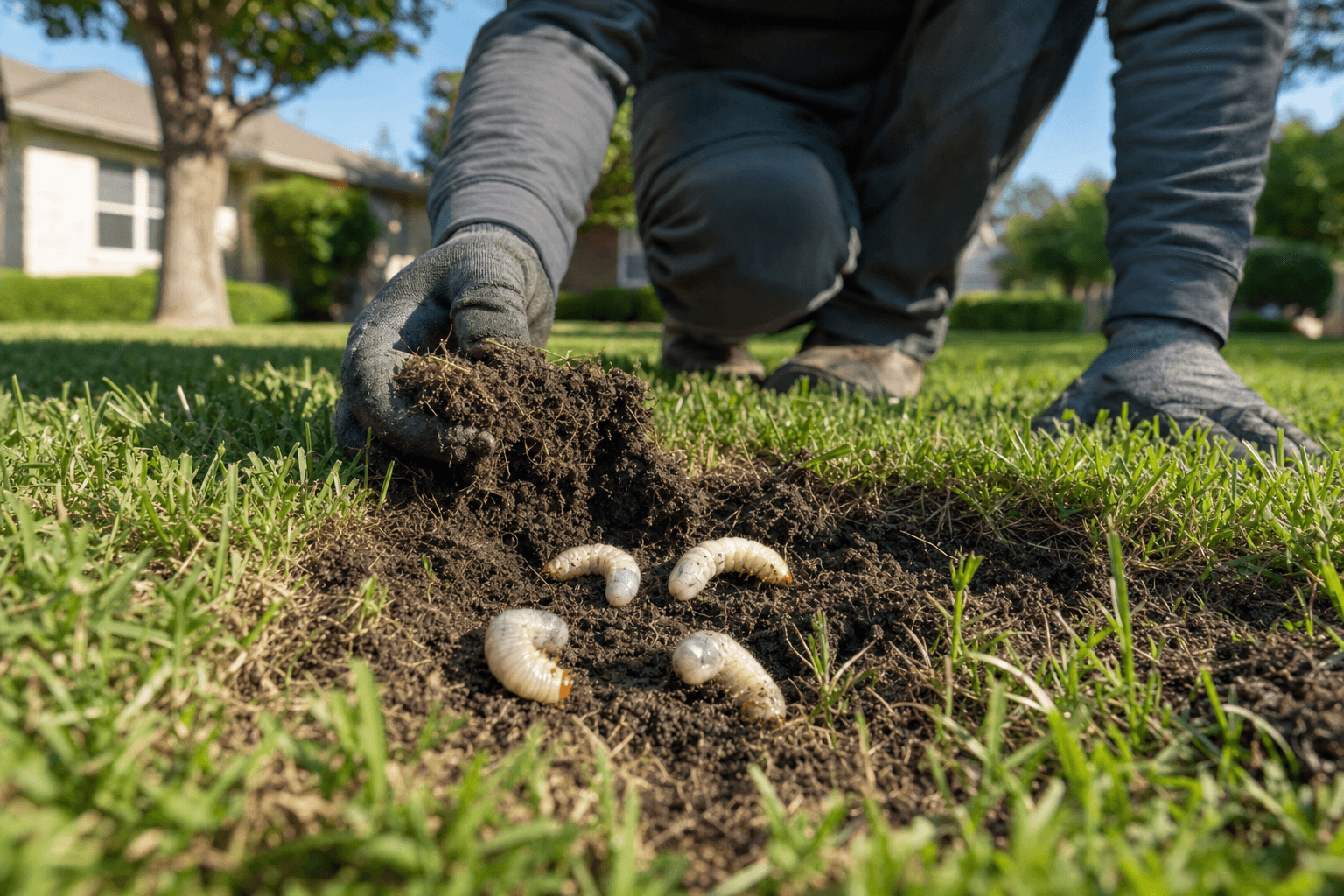
Option A: Preventive Grub Treatment
Preventive grub treatments are applied before grub populations establish and before feeding damage begins. In Central Texas, this means applying in late spring through early summer, right now in June, targeting newly hatched larvae from Japanese beetles and June bugs while they're still small and close to the soil surface.
The active ingredients most commonly used in preventive applications, such as chlorantraniliprole or imidacloprid, work by being absorbed into the root zone. When young larvae begin feeding on grass roots, they ingest the product and die before a damaging population can build up.
Pros:
- Stops damage before it happens, which means your turf stays intact through late summer
- More effective per application because larvae are small and vulnerable at this stage
- Protects the root system during the hottest, most stressful months for your lawn
- Lower overall product volume needed compared to curative treatments
Cons:
- You're treating a problem you can't yet see, which can feel like a gamble if you've never had grub pressure before
- Timing is strict. Applied too early or too late, the product misses the target window
- Some preventive products require adequate soil moisture to activate properly, which adds a watering step
Option B: Curative Grub Treatment
Curative treatments are applied after grubs are already established and feeding. By mid to late summer, homeowners start noticing the signs: spongy turf, brown patches that don't respond to watering, or turf that peels back like a loose carpet because the roots have been severed. That's when curative products come in.
Curative options like trichlorfon work faster than preventive products but require direct contact with larger, more developed larvae. Because these grubs are deeper in the soil and harder to reach, the application typically needs to be heavier and the timing more precise.
Pros:
- Useful when you've confirmed an active infestation and need to act quickly
- Addresses the problem that's already present rather than anticipating one
- Can be combined with lawn disease treatment or aeration as part of a recovery plan
Cons:
- Less effective than preventive treatments because mature larvae are harder to kill
- By the time you're applying a curative product, root damage has already occurred
- Recovery often requires additional steps like overseeding or topdressing to restore turf density
- Higher product rates and more precise application needed for adequate control
Key Differences: Cost, Timing, and Turf Recovery
The cost difference between these two approaches isn't just about the treatment itself. Preventive applications are typically less expensive because they use lower product rates and target a more vulnerable pest stage. Curative treatments cost more per application and almost always lead to additional lawn repair costs afterward.
Timing is the sharpest dividing line. Preventive treatments have a window of roughly late May through early July in Central Texas. Once that window closes and grubs mature, you're in curative territory whether you planned for it or not. Recovery timelines also differ significantly. A lawn treated preventively in June stays healthy through the fall. A lawn treated curatively in August may need fertilization support and overseeding before it looks right again, and that process can stretch into the following spring.
Grub Control Round Rock TX: What Makes This Area Specific
Round Rock sits on a mix of clay-heavy soils and areas with more sandy loam, particularly in newer developments pushing toward Hutto and Pflugerville. That soil variability matters for grub control round rock tx because clay soils retain moisture and heat differently than sandier profiles, and both affect how grubs move through the soil and how well products penetrate.
Bermuda grass is the dominant turf type across most Round Rock yards, and it's particularly vulnerable to grub damage during its peak growing season because root loss during summer stress compounds quickly. St. Augustine lawns, which are also common in older Round Rock neighborhoods, tend to show grub damage later but recover more slowly once the root system is compromised.
June bug pressure is consistent across Williamson County, and Round Rock properties near creek corridors or with heavier tree canopy, like areas near Brushy Creek, tend to see higher adult beetle activity, which translates to higher egg-laying density and more larval pressure by midsummer. That pattern makes preventive treatment a more reliable default than waiting to confirm damage.
For context on how grub pressure fits into broader lawn insect management in this region, and why timing decisions matter across multiple pest types, our post on getting ahead of grub damage in Georgetown covers the seasonal framework in detail.
What We Typically Recommend for Grub Control Round Rock TX
For most Round Rock homeowners in June, we recommend a preventive treatment without hesitation. The biology is straightforward: grubs are at their smallest and most vulnerable right now, the products work better at this stage, and the cost of prevention is significantly lower than the cost of repairing turf damage plus applying a curative product on top of it.
The only scenario where we'd lean toward a curative approach is if a homeowner confirms an existing, active infestation through a soil inspection and the preventive window has already passed. In that case, a curative application paired with a recovery plan makes sense, but it's a reactive position, not a strategic one.
If you've had grub damage in previous summers, or if your neighbors have dealt with it, that's enough history to justify preventive treatment as a standard part of your annual lawn care program. Grub pressure in Williamson County doesn't reset to zero each year. Consistent preventive applications are how lawns in this area stay ahead of the cycle rather than chasing it.
For broader homeowner context, University extension lawn care guidance and EPA lawn and garden water-saving guidance offer useful background on planning, safety, and maintenance decisions related to this kind of work.
Applying grub control round rock tx homeowners can count on starts with getting the timing right. If you'd like us to assess your lawn and recommend the right timing and product for your specific turf type, reach out to our team and we'll take a look before the preventive window closes for the season.
Need Help With This Service?
Request a quote and we will build a practical lawn plan for your property.
Book Consultation