
Good lawn and pest decisions should be grounded in practical science, including EPA integrated pest management principles and local extension guidance such as the University of Georgia Extension publications library .
Why June Is the Most Dangerous Month for Fungal Disease in Central Texas
Central Texas turf does not struggle because of one bad condition. It struggles because of several bad conditions stacking on top of each other at the same time. In June, daytime temperatures regularly push into the upper 90s and beyond, and the soil along the I-35 corridor between Georgetown and Cedar Park retains heat well into the evening. Overnight lows stay warm and humid, which means leaf blades on St. Augustine grass stay wet for extended periods. That moisture on the blade surface is where fungal spores take hold.
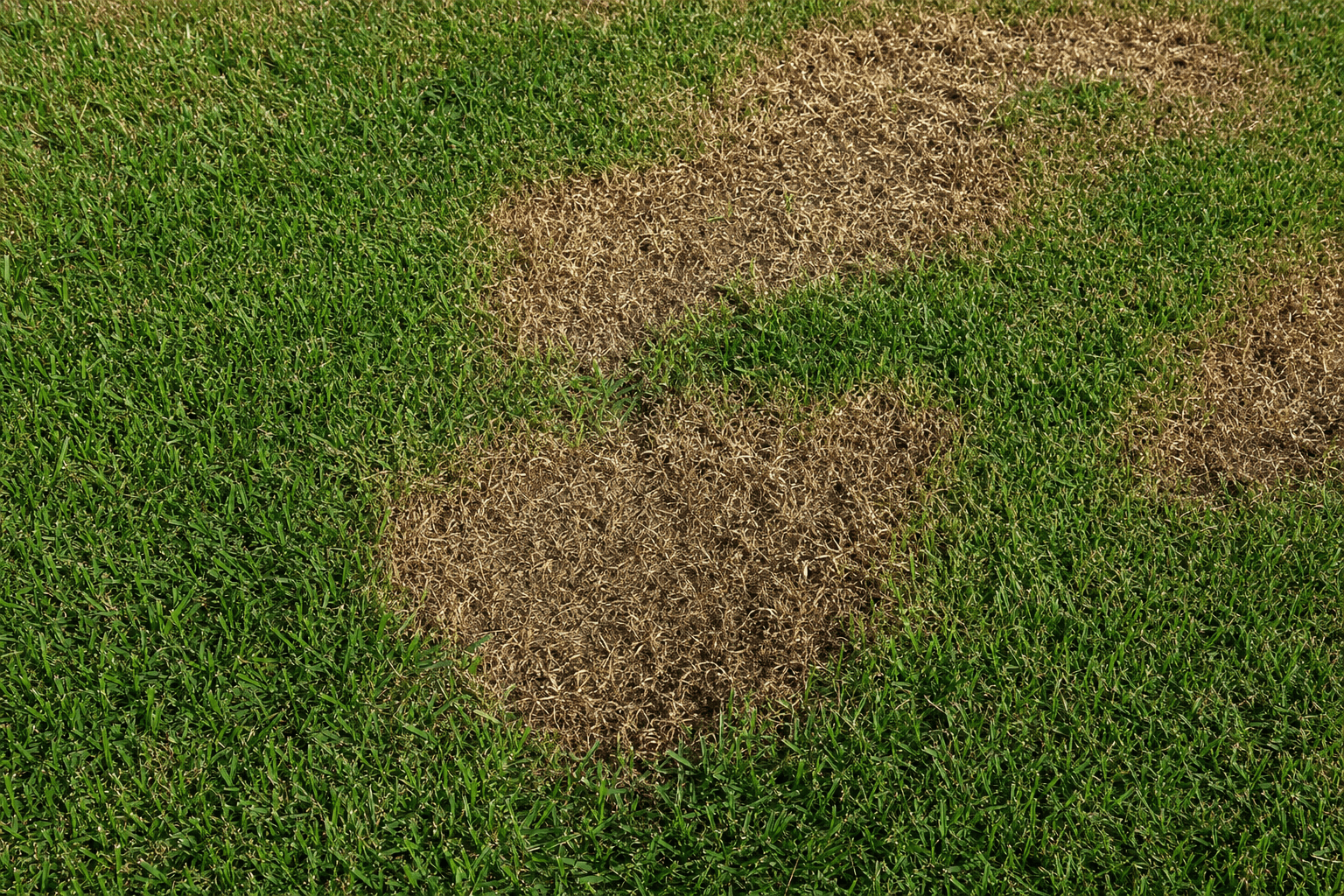
Brown patch, the most common fungal disease we treat this time of year, creates circular or irregular tan patches with a darker smoke ring at the outer edge. Take-all root rot is subtler at first, showing up as yellowing that looks like a nutrient deficiency before the roots begin to decay. Both diseases are often misread as drought stress or fertilization problems, which leads homeowners to water more or apply fertilizer, and both of those responses make fungal disease significantly worse.
Our team sees this pattern repeat every summer. A homeowner notices yellowing, increases irrigation frequency, and within two weeks has a spreading fungal infection that now covers a much larger area. If your lawn looked fine in May and is showing irregular discoloration now, lawn disease should be your first suspicion, not your last.
Identifying Lawn Disease Cedar Park TX Homeowners Are Seeing This Season
Diagnosis matters before treatment. Applying the wrong product, or applying a fungicide to a lawn that actually has a grub or root issue, wastes time and money and lets the real problem advance. Here is what to look for when you walk your lawn this week:
First, check the pattern. Drought stress tends to show up uniformly across the lawn, especially in high-sun areas. Fungal disease creates irregular patches, often circular, that do not follow the sun or shade pattern of your yard. Second, pull a few grass blades from the edge of a discolored patch and look at the base. Healthy blades pull cleanly from the crown. Diseased blades often slide out easily and may show discoloration or rot at the sheath. Third, check your irrigation timing. If your system is running in the evening or at night, you are creating the exact conditions that extend leaf wetness and accelerate fungal spread. Morning irrigation, finishing before 10 a.m., is one of the most effective cultural adjustments you can make right now.
Lawns that received heavy nitrogen fertilization in late spring are also at elevated risk. Lush, fast-growing turf is more susceptible to brown patch than turf that was fertilized conservatively. Our lawn fertilization approach in summer accounts for this by adjusting nitrogen inputs to avoid pushing excessive soft growth during peak disease season.
What Professional Treatment Actually Involves
Over-the-counter fungicides exist, but timing, product selection, and application rate matter more than most homeowners realize. Fungal diseases in St. Augustine grass often require multiple applications on a specific interval, and using a systemic fungicide versus a contact fungicide at the wrong stage of infection produces very different results.
Our lawn disease treatment process starts with a proper diagnosis on-site, because treating for brown patch when the lawn actually has take-all root rot requires a different product and a different approach. We also look at contributing factors: thatch depth, soil compaction, drainage patterns, and irrigation scheduling. Addressing those underlying conditions is what prevents recurrence. A fungicide application that is not paired with corrective cultural practices will buy you a few weeks of relief before the disease returns.
For lawns with compaction issues contributing to poor drainage and prolonged moisture retention, aeration later in the season helps reduce that risk going forward. Some lawns also benefit from topdressing to improve surface drainage and soil biology. These are longer-term solutions, but they matter if your lawn has had recurring disease problems across multiple summers.
Other June Threats That Look Like Lawn Disease Cedar Park TX
Not every problem is fungal, and that is worth saying plainly. Grub damage from June beetle larvae can cause turf to lift and die in patches that closely resemble disease. Chinch bugs , which are extremely active in hot, sunny Central Texas lawns right now, create yellowing and browning that is frequently misidentified as brown patch. Chinch bug damage tends to appear first in the hottest, driest areas of the lawn, often near driveways, sidewalks, and south-facing slopes.
We also see fire ant activity increase significantly in June, and their mound-building disrupts root systems in localized areas. If you are seeing multiple types of damage across different zones of your lawn, a professional assessment is the fastest path to an accurate answer. Our team serves homeowners across Georgetown, Cedar Park , Leander , and Round Rock , and we are actively treating all of these issues right now.
The Timing on This Is Real
Lawn disease cedar park tx does not pause while you decide. Brown patch spreads fastest during the exact conditions June delivers, and a patch that is 18 inches across today can triple in size within two weeks if temperatures and humidity hold. By mid-July, lawns that went untreated in June often have damage so extensive that recovery requires significant renovation, including overseeding or resodding in affected zones. That pushes the real cost of waiting well past the cost of early treatment.
If you are seeing any of the signs described above, this week is the right time to get eyes on your lawn. Reach out to our team through the Green Dream Lawns contact page and let us take a look before the July heat makes this a much harder problem to solve.
Need Help With This Service?
Request a quote and we will build a practical lawn plan for your property.
Book Consultation