
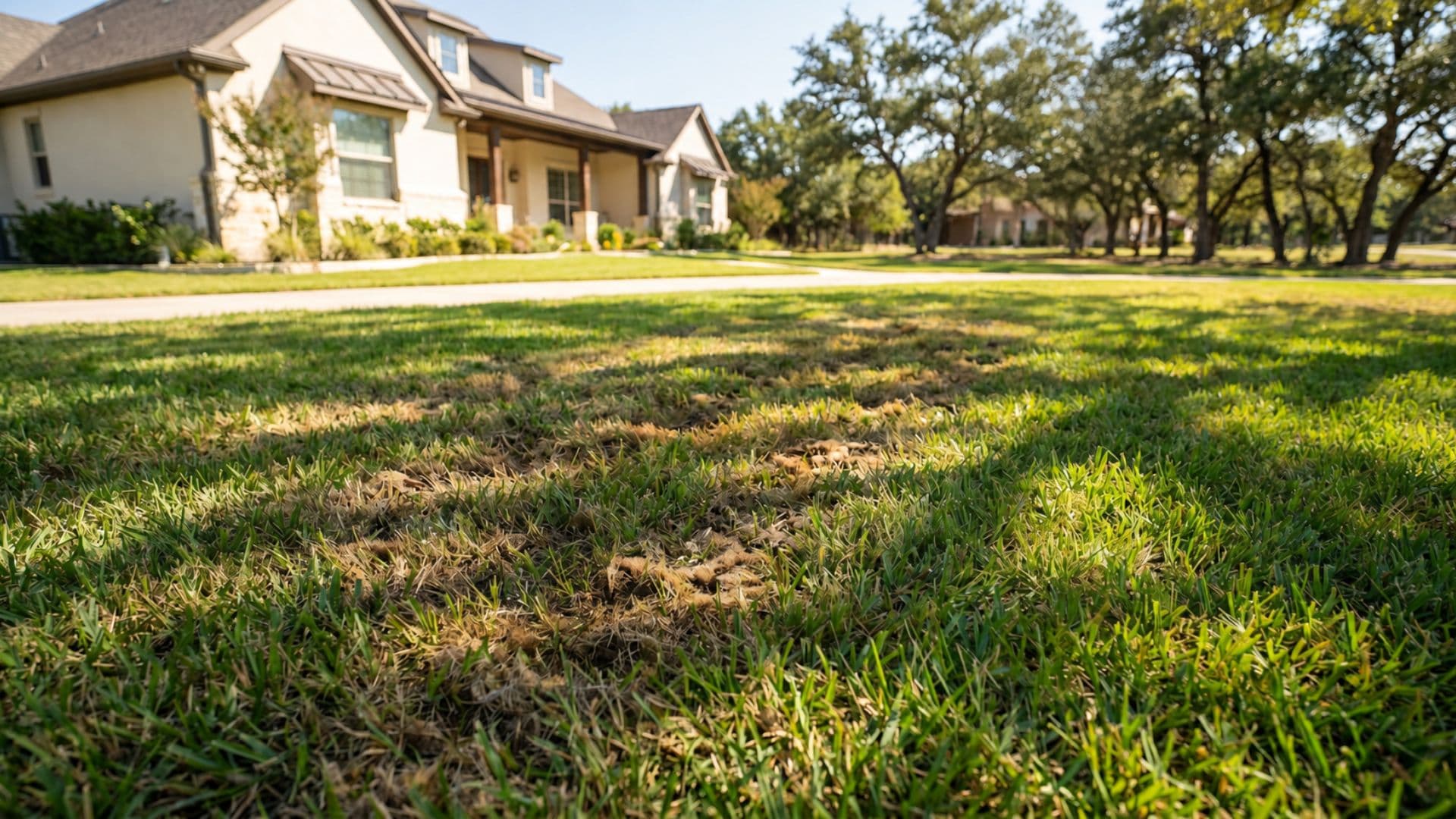
In Round Rock, a lot of the disease pressure comes from compacted soils under established subdivisions. Out here, it often comes from the land itself, the way water pools in low spots after a spring rain, and the way morning dew lingers across open acreage well into mid-morning. One treatment program does not work across both areas, and that is something our team has learned over years of working in this part of Williamson County.
Why Spring in Florence Sets the Stage for Lawn Disease
April is when we start fielding the most calls about turf that looked fine in March and suddenly has irregular brown patches, greasy-looking rings, or a bleached-out color that does not respond to watering. This is not drought stress. This is fungal activity, and Central Texas springs create ideal conditions for it. Nighttime temperatures are still dropping into the low 50s while daytime highs push into the upper 70s and low 80s. That temperature swing, combined with the humidity that builds ahead of spring storm systems rolling through, gives pathogens exactly what they need to establish and spread.
Out near the Florence city limits and along CR 200, the Bermuda and St. Augustine lawns we service tend to break dormancy a little slower than turf in more urban areas. That slow green-up period is actually a vulnerability window. The grass is actively growing but not yet vigorous enough to outpace disease pressure. If you have already been watching your lawn for signs of trouble this spring, our post on why lawns turn brown and straw-colored in Central Texas can help you separate disease symptoms from other causes before you call.
The Most Common Lawn Diseases We See in Florence
Brown patch is the most frequent diagnosis we make on St. Augustine turf in this area during April and May. It presents as circular or irregular patches that expand outward, often with a darker, water-soaked border at the edge of active spread. NC State Extension notes that brown patch thrives in warm, humid conditions , which lines up closely with what we see during wet Central Texas springs.
Take-all root rot is the other major problem we see, and it is more insidious because it does not always look like a disease at first. The turf just looks weak, yellow, and thin. Roots are short and dark. It is often misread as a fertilization problem, which leads homeowners to apply nitrogen and actually accelerate the disease. NC State's turf guidance on take-all root rot echoes that pattern, especially on stressed lawns. If you have been fertilizing and your lawn is still declining, this one deserves a closer look from a professional. Our guide to lawn fertilization in Florence, TX goes into how soil chemistry and timing interact with turf health in ways that are specific to this area.
Gray leaf spot also shows up on St. Augustine during warm, wet stretches, particularly on lawns that have received heavy nitrogen applications earlier in the season. It looks like small tan lesions with darker borders, and it spreads quickly when conditions stay humid for several days in a row.
How Soil and Drainage in Williamson County Amplify Disease Risk
The soils around Florence are not uniform. You have areas with heavy black clay that drains poorly and holds surface moisture for extended periods after rain. You have transitional soils closer to the Lampasas River watershed that drain better but are more prone to drought stress, which weakens turf and opens it up to opportunistic disease. We treat these situations differently, and a program that works on one property may not be appropriate for a neighbor down the road.
Lawn disease in Florence, TX is a real and recurring challenge partly because of how this land behaves after weather events. A two-inch rain in April does not drain the same way here as it does in a subdivision built on engineered fill. When water sits on the surface or pools at low points in a lawn for 12 to 24 hours, it creates the exact conditions that fungal pathogens need to germinate and spread. Core aeration is one of the tools we use to address this, improving drainage and reducing the surface moisture that feeds disease cycles. Our spring lawn prep guide for Central Texas covers how aeration fits into a broader program that supports disease resistance.
What a Proper Treatment Program Actually Involves
Treating lawn disease effectively is not just about applying a fungicide and moving on. Fungicides work on contact and through systemic uptake, and timing matters enormously. Applying a curative fungicide after a disease has already destroyed the crown of a plant will not bring that tissue back. The goal is either preventive applications during high-risk windows or early curative treatment the moment symptoms appear.
Our disease management approach starts with an accurate diagnosis, because different pathogens require different active ingredients. Brown patch responds to products that do not touch take-all root rot. Misidentifying the problem leads to wasted money and continued turf loss. We also look at the broader program, including mowing height, irrigation timing, and fertility levels, because disease rarely exists in isolation. A lawn under nutritional stress, or one that gets watered late in the evening, is going to fight disease from a weaker position regardless of what we apply.
If your lawn is showing new brown patches, thinning, or areas that stay wet after every storm, the best next step is a site-specific diagnosis. Contact Green Dream Lawns and we can help you figure out whether you are dealing with fungal pressure, irrigation issues, or a broader lawn health problem before the damage spreads.
Need Help With This Service?
Request a quote and we will build a practical lawn plan for your property.
Book Consultation