
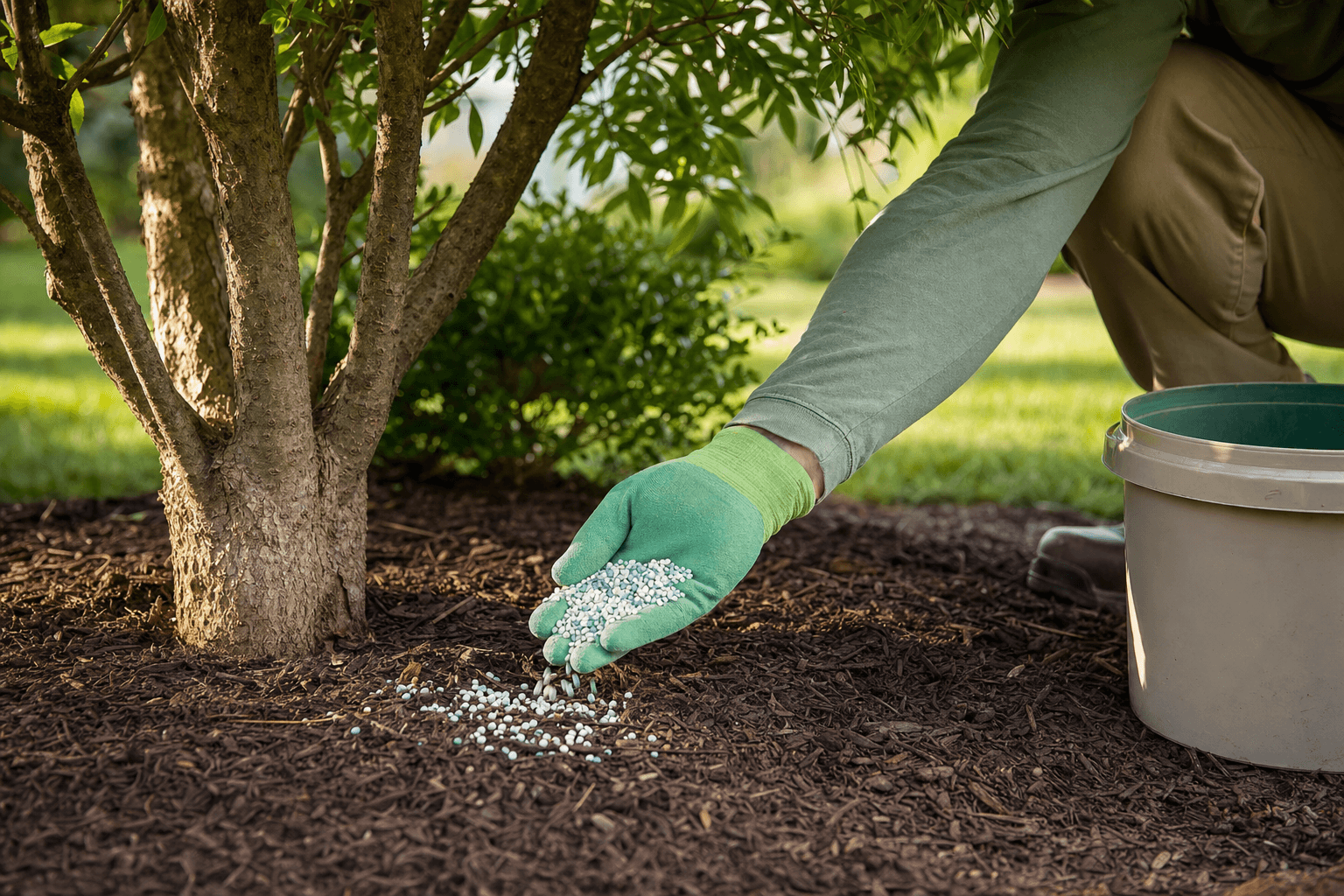
Plant fertilization in Liberty Hill, TX means applying the right macro and micronutrients directly to ornamental shrubs, perennials, and trees on a schedule calibrated to local soil chemistry and seasonal stress. Liberty Hill's alkaline soils commonly lock out iron and manganese, so effective programs address pH-driven deficiencies alongside standard nitrogen, phosphorus, and potassium needs. Treatments are typically applied in late spring and mid-summer, with adjustments made based on plant response and soil conditions. A soil-informed fertilization plan helps avoid adding nutrients the plants do not need.
Key Takeaways
- Liberty Hill's alkaline clay and caliche soils frequently cause iron and manganese deficiencies in ornamentals, requiring targeted micronutrient applications beyond basic NPK feeding.
- Mid-summer fertilization for shrubs and ornamentals requires lower nitrogen concentrations than spring feeding to avoid burning stressed plants during peak heat.
- Plants along CR 200 and in developments like Sundance Ranch show visible decline faster than turf because their root zones are shallower and more exposed to compacted fill soils.
- Combining plant fertilization with plant insect and disease control is often necessary in July because nutrient-stressed plants attract spider mites and scale insects.
- Green Dream Lawns serves Liberty Hill as part of a broader Central Texas service area that includes Georgetown, Leander, and surrounding communities.
Why Liberty Hill Soil Makes Plant Fertilization Different From Anywhere Else in Williamson County
Drive out past the Liberty Hill High School campus toward the older ranches along CR 200 and you start to see the geology that defines this area. The topsoil thins out quickly, and underneath you hit either tight clay or caliche hardpan. Both soil types create the same core problem for ornamentals: nutrient lockout. When soil pH climbs above 7.5, which is common across Liberty Hill, iron and manganese become chemically unavailable even when those elements are technically present. You'll see it as interveinal chlorosis , the yellowing between leaf veins on Indian hawthorn, photinia, and live oak that homeowners often mistake for a watering problem.
Our plant fertilization programs account for this directly. We're not just applying a generic granular blend and walking away. In alkaline conditions, chelated micronutrients are far more bioavailable than standard sulfate forms, so the product selection matters as much as the timing. For established shrubs and ornamentals in Liberty Hill, we typically incorporate iron chelate applications alongside a balanced slow-release fertilizer to address both the immediate deficiency and the long-term feeding demand.
This is also why lawn fertilization and plant fertilization are separate services with separate protocols. Turf responds well to high-nitrogen programs because grass has a dense, fibrous root system that can handle heavier feeding. Ornamental shrubs and perennials have different nutrient ratios and root architectures. Applying a lawn-grade fertilizer to your landscape beds is one of the more common mistakes we see, and it usually results in salt burn or a flush of weak, leggy growth that makes plants more vulnerable heading into the hottest part of summer.
What Does Plant Fertilization in Liberty Hill, TX Actually Look Like in July?
July is not the month for aggressive feeding. We want to be direct about that. By the time we're in the middle of summer, the goal shifts from promoting new growth to supporting what's already there. Plants under heat stress have reduced metabolic activity, which means they absorb nutrients more slowly. Pushing high nitrogen into a stressed plant in 105-degree heat is a reliable way to cause more damage than the deficiency you were trying to fix.
For plant fertilization in Liberty Hill, TX during mid-summer, our approach focuses on micronutrient correction, modest potassium supplementation to support drought tolerance, and foliar applications where soil uptake is compromised by dry conditions. We also pay close attention to plants in newer subdivisions like Sundance Ranch, where the original topsoil was often stripped during construction and replaced with compacted fill. Those plants are working with almost nothing in terms of organic matter or microbial activity, and they need more frequent attention than established plantings on older properties.
For trees showing signs of stress, we often recommend pairing fertilization with Arbor Jet injections , which deliver nutrients and treatments directly into the vascular system of the tree rather than relying on root uptake through difficult soils. This is particularly useful for mature live oaks and cedar elms that have root zones extending into compacted areas or under hardscape.
How Does Insect Pressure Connect to Nutrient Deficiency in Liberty Hill Plants?
One pattern we see repeatedly in Liberty Hill and across our Leander and Cedar Park service areas is the relationship between nutrient-stressed plants and insect infestations. Spider mites, aphids, and scale insects are drawn to plants that are already weakened. A photinia hedge that has been struggling with iron deficiency for two seasons is a much easier target than one that's been on a consistent feeding program.
This is why we often coordinate plant insect and disease control alongside fertilization visits rather than treating them as separate problems. If we're out there addressing a nutrient program and we spot early scale activity on a wax myrtle or lace bug damage on a Texas mountain laurel, addressing both in the same visit makes far more sense than scheduling a return trip. Waiting on the insect pressure while you correct the nutrient deficiency just means the plant is fighting two battles at once.
Broader plant and tree care in Liberty Hill really does function as a system. Fertilization, insect control, and disease management are all connected, and treating them in isolation tends to produce slower results and higher long-term costs.
Frequently Asked Questions
Is July too late to start a plant fertilization program in Liberty Hill?
It is not too late, but the approach changes. Mid-summer applications focus on micronutrient correction and stress support rather than pushing new growth. Starting a program in July still provides meaningful benefit, particularly for plants showing chlorosis or insect pressure, and positions them to recover well going into fall.
Why are my shrubs turning yellow even though I water them regularly?
In Liberty Hill, yellowing between leaf veins is usually a sign of iron or manganese deficiency caused by the area's alkaline soil, not a lack of water. The nutrients may be present in the soil but are chemically unavailable at high pH levels. Chelated iron applications and a proper fertilization program typically resolve this within a few weeks.
Can I use the same fertilizer on my shrubs that I use on my lawn?
We strongly advise against it. Lawn fertilizers are formulated for high-nitrogen demand in turf and can burn ornamental shrubs or cause weak, vulnerable growth. Shrubs, perennials, and trees need different nutrient ratios and often require micronutrient supplementation that standard lawn products do not provide.
Does Green Dream Lawns serve all of Liberty Hill, including newer developments?
Yes, we serve Liberty Hill as part of our Central Texas service area, including newer subdivisions like Sundance Ranch where construction-related soil disturbance is a common factor in plant health problems. You can find more information on our Liberty Hill service area page or contact us directly to discuss your property's specific needs.
Liberty Hill is growing fast, and with that growth comes a lot of newly planted landscapes sitting in compromised soils with no established feeding history. The plants along those new streets and cul-de-sacs are quietly struggling through their first or second summer with very little support. Plant fertilization in Liberty Hill, TX is one of the most straightforward ways to change that outcome, and the window to act before fall is still open.
Not sure what your plants need? Green Dream Lawns can evaluate the site, explain which conditions may be limiting your shrubs and ornamentals, and recommend a targeted plan. Review our plant fertilization service or request a Liberty Hill property evaluation .
Need Help With This Service?
Request a quote and we will build a practical lawn plan for your property.
Book Consultation