
Site planning is stronger when it accounts for local soil and runoff patterns, so resources like the USDA Web Soil Survey and EPA stormwater guidance can help frame the right questions before work begins.
What Professional Weed Control Actually Involves
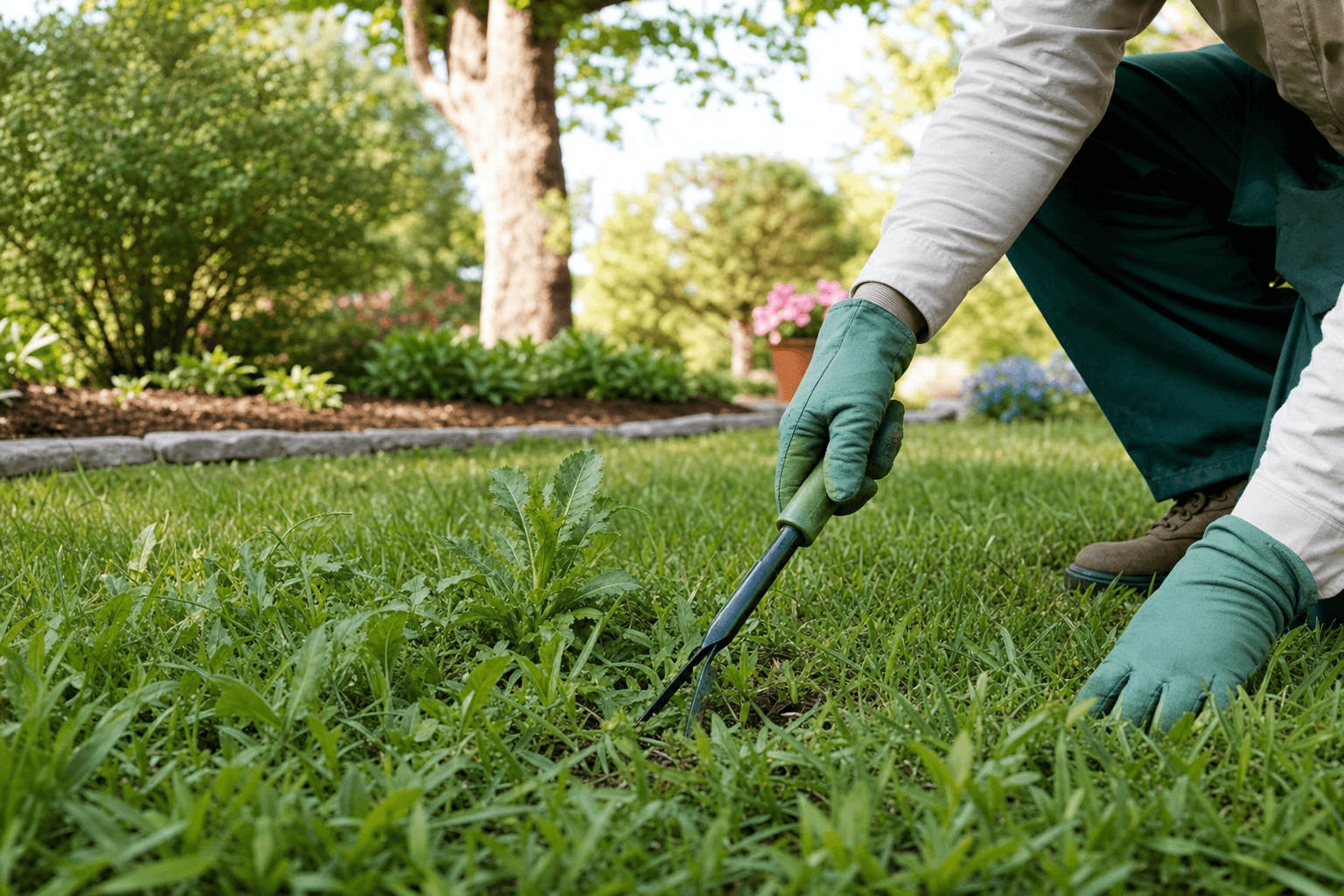
Weed control is not a single product or a single visit. It is a layered approach that combines pre-emergent herbicides, post-emergent herbicides, and in some cases, targeted spot treatments, all timed around the growth cycles of specific weed species and the current state of your turf.
Pre-emergent herbicides work by creating a chemical barrier in the soil that prevents weed seeds from germinating. They do not kill existing weeds, and they do not affect grass that is already established. Timing is everything with pre-emergents. Apply too early and the barrier breaks down before the weed pressure arrives. Apply too late and seeds have already germinated below the surface, making the product largely ineffective. For spring weed pressure in Florence, TX, we are typically targeting soil temperatures around 55 to 60 degrees Fahrenheit as the trigger point for pre-emergent applications.
Post-emergent herbicides work differently. These are applied directly to weeds that are already growing and actively green. Selective post-emergents are formulated to target broadleaf weeds or grassy weeds without harming the surrounding turf. Non-selective post-emergents kill whatever they contact, which is why they are reserved for situations like bed edges, fence lines, or hardscape borders rather than open lawn areas.
For a complete breakdown of how fertilization fits alongside this process, our lawn fertilization guide for Florence, TX explains how nutrient applications are scheduled around weed control visits to avoid interference between the two.
Why Weed Control Florence TX Requires a Different Approach Than Other Regions
The Williamson County soil profile that runs through the Florence area presents a specific challenge. Much of this land sits on shallow, rocky clay over caliche, which drains poorly after heavy rain and bakes hard during dry stretches. That cycle of saturation and drought stress weakens turf density, and thin turf is exactly where weeds establish most aggressively. Crabgrass, dallisgrass, and nutsedge thrive in compacted or stressed soil. Broadleaf weeds like dandelion, clover, and henbit move in wherever the grass canopy has gaps.
The other factor is the dual weed season. Central Texas sees a cool-season weed flush in late fall and winter, then a warm-season flush that kicks off in spring and runs through summer. That means a single annual treatment is not enough. Effective weed control florence tx requires pre-emergent applications timed for both windows, typically one in early fall ahead of cool-season germination and one in late winter or early spring ahead of warm-season germination. Right now, in April, we are in the middle of that warm-season window. Weeds that were not controlled by a pre-emergent in February or early March are already visible, and post-emergent applications are the appropriate response at this point in the calendar.
What to Expect During a Weed Control Visit
A standard weed control visit from our team involves a property walkthrough before any product is applied. We are looking at weed species present, turf density, any visible stress or disease, and whether the lawn has been recently mowed or watered. These details affect product selection and application rate.
For liquid applications, we use ride-on or walk-behind sprayers with boom or hand-wand attachments depending on the property layout. Granular pre-emergents are spread with calibrated rotary spreaders. Most residential visits in Florence run between 20 and 45 minutes depending on lot size and the complexity of the property.
After application, we ask homeowners to keep foot traffic and irrigation off the treated area for a minimum of 24 hours, or longer if rain is not expected and the product needs moisture to activate. Post-emergent applications typically show visible results within five to ten days. Some weeds, particularly perennial grassy weeds like dallisgrass, may require a second application a few weeks later because of how their root systems store energy.
One thing homeowners often ask about is lawn safety during and after treatment. We covered this in detail in our post on safe weed control for lawns with children and pets , which explains re-entry intervals and what the label data actually says about product safety once dry.
How to Know When Your Lawn Needs Professional Weed Control
The clearest sign is visible weed coverage across more than 10 to 15 percent of your lawn surface. At that threshold, hand-pulling or consumer-grade spot sprays rarely keep pace with the problem, especially with perennial species that regrow from root fragments or underground tubers.
A less obvious sign is recurring weed pressure in the same spots year after year. That pattern usually points to a soil compaction issue or a drainage problem that is creating ideal germination conditions. Weed control florence tx is most effective when it is paired with aeration and overseeding in those problem zones, which addresses the underlying turf density issue rather than just the symptom.
Another indicator is weed species that are difficult to control without professional-grade products. Nutsedge, for example, does not respond to most broadleaf herbicides. It requires a product specifically labeled for sedge control, applied at the right rate and timing. Getting that wrong can mean wasting an entire season.
If your lawn has been dealing with consistent weed pressure and you want an assessment of what is actually driving it, reach out to our team and we can walk the property and put together a treatment plan based on what we actually see. The warm-season window is already open, and the weeds that germinated in March are actively competing with your turf right now.
Need Help With This Service?
Request a quote and we will build a practical lawn plan for your property.
Book Consultation